
Swine Artificial Insemination Operation Manual
Read the complete illustrated DOLO swine Artificial Insemination (A.I.) operation manual online, with an optional watermarked PDF download.
Read online ↓ Download PDFContents
Foshan Duole Livestock Equipment Co., Ltd. — Duole Livestock / Pig Fairy
Artificial Insemination — The Most Scientific Choice for Healthy Pig Production!
| Aspect | Natural mating | Artificial insemination |
|---|---|---|
| 1. Economics | Boar-to-sow ratio 1:20 | Boar-to-sow ratio 1:100–400 |
| 2. Quality | Semen quality cannot be controlled | Semen with the best genetic level can be selected |
| 3. Convenience | Inconvenient to replace boars | Quality semen can be purchased from other farms and stations |
| 4. Disease prevention | Venereal diseases are easily transmitted | Venereal disease transmission can be prevented |
| 6. Management | High cost; difficult to control and plan | All-in/all-out system is easy to implement and benefits are maximized |
5. Diseases that can be avoided through artificial insemination: atrophic rhinitis (AR), Pasteurella multocida (PM), Actinobacillus pleuropneumoniae (AP), polyserositis, swine enzootic pneumonia (SEP), Japanese encephalitis (JE), transmissible gastroenteritis (TGE), swine erysipelas (SE), swine dysentery (TH), toxoplasmosis (TP), mange mite infestation, colibacillosis, and others.
Practical technical tips on artificial insemination of exotic breed swine.
I. Benefits of Applying and Promoting AI Technology in Exotic Breed Swine
The following illustrative cost comparison uses Chinese renminbi (CNY/RMB). Amounts are examples from the original manual, not a current quotation. Take a farm raising 1,000 exotic-breed sows as an example: with natural mating, one boar can serve 25 sows per year, so 40 breeding boars would be required. With artificial insemination, one boar can serve 150–400 sows; calculated at 250 sows per boar, the farm needs only 4 breeding boars. Cost comparison: each boar consumes 800 kg of feed per year with a feed cost of at least CNY 1,500 per year, so artificial insemination saves about CNY 54,000. Calculating with one-third of boars culled each year, natural mating culls 13 boars while artificial insemination culls only 2; at a purchase price of CNY 4,000 per replacement boar, artificial insemination saves CNY 44,000 on boar purchases. Using artificial insemination costs about CNY 33 per sow per year (including disposable insemination bottles, catheters, extender, and other supplies); breeding 1,000 sows costs CNY 33,000. Together with the savings on boar housing and labor, the economic benefits of artificial insemination are obvious.
II. Estrus Detection and Timely Insemination of Exotic Breed Sows
Estrus detection and timely insemination are the key technical links in applying AI to exotic breed sows, as well as the difficulty and focus of its application and promotion. The authors believe that, in researching and promoting AI of exotic breeds, great efforts must be devoted to solving the problem of timely insemination and mating of sows.
1. Age and Body Weight at First Mating
Sexual maturity of exotic breeds varies greatly with management, climate, environment, nutrition, and individual conditions, and comes later than in Chinese local breeds. Under good management, exotic gilts reach puberty at 5–6 months of age; they are first mated at 7–8 months of age and at a body weight of 110–120 kg or more. The first and second heats are not mated; mating takes place at the third estrus.
2. Estrus Detection
The estrus signs of exotic sows vary greatly with breed, parity, and individual and are much less pronounced than in Chinese local breeds: the vulva is small with little redness and swelling, little mucus flows from the vagina, and there is no obvious abnormal reaction.
Sows come into estrus about every 21 days on average; an estrous cycle of 17–25 days is regarded as normal. Each estrus lasts 3–7 days, varying with the individual and climate conditions, and is somewhat shorter in hot weather. Weaned sows usually return to estrus 4–7 days after weaning. For easier observation and detection, the estrus period is divided into three stages when performing AI.
(1) Proestrus
Lasting 1–2.5 days. The sow’s vulva swells and reddens, and a watery to slightly thick milky-white mucus may flow from the vulva. After 1–3 days the vulvar swelling intensifies; the sow appears somewhat restless or shows little change, but does not accept mounting when the boar approaches. This is the stage when the ovarian follicles prepare to develop: new follicles begin to form, the reproductive tract becomes mildly congested and swollen, glandular activity gradually increases, the uterine cervix gradually relaxes, the cervical os opens, and the uterus and vagina begin to secrete mucus, preparing the sow for conception.
(2) Estrus (Mating Period)
Lasting 1.5–2.5 days. At this stage the sow shows sexual desire: she has a standing reflex and accepts the boar. The vulva is congested and swollen; later the swelling slightly subsides with fine wrinkles, and the color changes from red to purplish red then fades. The sow becomes restless, sometimes grunting, going off feed and pacing the pen, mounting others, urinating frequently, approaching the stockman, and appearing dazed. A rather thick, creamy, ropy mucus flows from the vulva; the vagina and cervix are relaxed and congested, and feel warmer than usual. This is also the ovulation peak of the sow — the most suitable time for insemination and mating.
(3) Metestrus
Lasting 1.5–2 days. The vulvar swelling recovers to normal, the sow shifts from sexual excitement to a quiet state, the cervical canal contracts, glandular secretion gradually weakens, and the mucus becomes scant and viscous. The sow’s behavior returns to normal and she enters diestrus.
3. Estrus Symptoms of Exotic Breed Sows
Estrus signs differ greatly with the individual, breed, and parity. If one, or two or more, of the following signs appear, the sow should be observed closely in production to judge whether she is in estrus:
- Dazed expression, behaving more affectionately toward the stockman than usual.
- Sensitive and alert, head tilted as if listening, often with ear movement and frequent urination.
- Restless in the pen, nuzzling the gate, trying to approach the boar or sows in the neighboring or same pen.
- Vulva red and swollen, with the redness and swelling gradually deepening.
- Loss of appetite or going off feed.
- Mucus appears at the vulva.
- Standing reflex: when pressing the flank and back, the sow stands rigidly, with ears pricked and the tail raised; she stands calmly when a person rides her, looking comfortable. If the sow cannot be moved away from her place after this standing reflex appears, she is already fully in estrus.
4. Timely Insemination
Timely insemination is the key point in applying and promoting AI technology in exotic breeds. Pigs ovulate simultaneously from both ovaries, and ovulation is concentrated in the mid-to-late estrus — that is, during the sow’s standing-heat period. Within 24–36 hours after the sow accepts mounting, about 65% of the total ova are ovulated; if mated during this period, the conception rate can reach 100%. The sow’s ovulation lasts a long time, with intervals of 7–12 h; sperm survive in the sow’s reproductive tract for about 8–15 h. After ovulation, the ova take about 6–12 h to reach the ampulla of the oviduct (the fertilization site), while sperm reach the oviductal ampulla in about 15–30 min; after ovulation, the ova retain fertilizing capacity for about 8–12 h. It can be seen that both the sow’s ova and the boar’s sperm have very short survival and fertilization-capable windows. Therefore, the optimal mating period should be controlled within 19–36 h after estrus onset, and mating must be completed no later than 48 h after estrus. Since the onset of estrus is not easy to judge accurately when applying AI to exotic breeds, the most reliable signs are those of standing heat: when the sow’s vulva is heavily congested with wrinkles, she likes to mount other pigs, stands rigidly and shows a standing reflex when her loin is pressed, and white, thick mucus that can be pulled into threads 2–3 cm long flows from the vagina — that is the best time for insemination.
In commercial AI practice, double mating is strongly recommended: re-inseminate the sow 8–24 h after the first insemination. In practice, check sows for estrus twice a day: if estrus is found in the afternoon, inseminate on the next morning and repeat on the next afternoon; if estrus is found in the morning, inseminate that afternoon and repeat on the next morning. Timing should also be adjusted according to the sow’s parity.
III. Factors Affecting AI Results in Exotic Breed Swine
Duole Livestock would particularly point out: anyone on any farm applying and promoting swine AI technology should keep good records, so that the AI results can be summarized and analyzed — detailed records and comparative studies of the conception rate per estrus, litter size, and sow reproductive tract diseases. When the sow’s estrus conception rate and litter size are lower than those of natural mating, or the proportion of metritis increases, the causes must be carefully analyzed; when analyzing the good or poor results of AI application, the following aspects should be considered.
1. Human Factors
Human factors (technical factors and the staff’s sense of responsibility) are important influencing factors on the sow’s estrus conception rate and litter size.
(1) Estrus Detection and Timely Insemination
Inadequate judgment of estrus detection and timely insemination — such as starting insemination as soon as the sow shows the standing reflex, or only noticing estrus when it is already over — will reduce the sow’s conception rate and litter size.
(2) Inadequate Insemination Preparation
Before insemination, if the sow’s vulva is not clean, bacteria or viruses can easily be carried into the vagina or uterus through the insemination catheter, causing sow metritis and other diseases and thereby affecting the AI results. Therefore, before every insemination the sow’s vulva should be cleaned first and then wiped dry with toilet paper.
(3) Insemination Method
When inserting the insemination catheter, check that it has not entered the urethra. Insert it at a 45° upward angle with appropriate force; never force it, so as not to injure the sow’s vagina. Western-breed sows are generally large-bodied with long loins, so the insertion depth must be deeper than for indigenous pig breeds — the catheter must be inserted to the sow’s uterine cervix, and it is properly placed once slight resistance is felt when pulling it back. Stimulate the sow’s udder to enhance her excitability and improve the effectiveness of artificial insemination.
(4) Duration of insemination. Based on practical production experience, the insemination duration should match the duration of natural mating — keep it at 5–15 min. After insemination is completed, leave the catheter in place for 30 minutes, then gently remove it.
(5) Sow posture after insemination. If a sow lies down immediately after semen has been delivered, the semen easily flows backward, which impairs the result of artificial insemination. Therefore, after insemination, slap the sow’s rump to keep her standing.
(6) Technician skill level. Technology is the primary productive force. Technicians with a high skill level generally achieve good artificial insemination results. Therefore, a farm should identify and train promising staff from among its many technicians, promoting the best and weeding out the worst, to achieve solid results in pig artificial insemination.
2. Boar semen. The quality of boar semen is an important factor affecting the sow’s conception rate during estrus and litter size. However, when good artificial insemination technicians and mating attendants are available, this problem can be resolved.
3. Sows.
(1) Sow body condition. Sows that are too fat or too thin due to lactation or other reasons show weak estrus signs; even when inseminated at the proper time after estrus, they easily return to estrus. This relates to the adjustment of the sow’s diet and body condition.
(2) Sow diseases. If sows suffer from reproductive diseases such as swine fever or Japanese encephalitis, they easily return to estrus after insemination; even if conception occurs, it often leads to early embryonic death or latent metritis, and no amount of insemination will result in pregnancy. In other words, when a sow has certain diseases, the result of artificial insemination may be poor. Therefore, treat the sow before insemination.
(3) Blocked oviducts in sows. Congenital or disease-related blockage of the sow’s oviducts naturally makes artificial insemination ineffective, but such cases are usually rare.
4. Transport of semen at insemination time. Before insemination in summer or winter, if the transport distance is long, the semen must be transported under temperature control at 17°C. In practical production, a vehicle-mounted thermostatic transport box can be used to store semen — one of the foundations for improving the conception rate.
5. Equipment and supplies. The equipment, tools, and consumables used when applying artificial insemination technology to exotic pig breeds also largely affect the application of the technology, and constitute one of the important foundations for its effective use.
Foshan Duole Livestock Equipment Co., Ltd.
8 Important Steps for Successful Pig Artificial Insemination
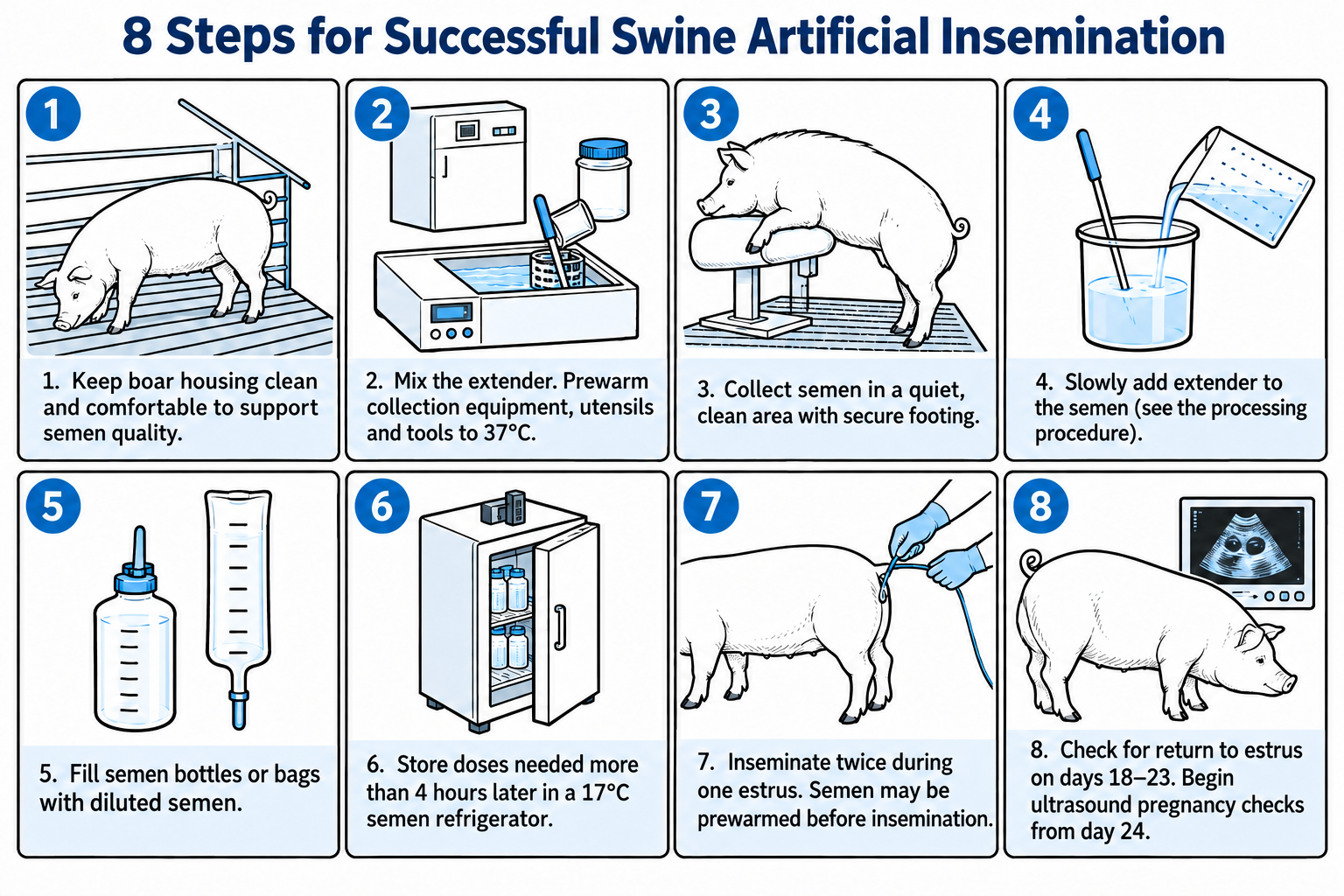
- Keep boar housing clean and comfortable to support semen quality.
- Mix the extender. Prewarm collection equipment, utensils and tools to 37°C.
- Collect semen in a quiet, clean area with secure footing.
- Slowly add extender to the semen (see the processing procedure).
- Fill semen bottles or bags with diluted semen.
- Store doses needed more than 4 hours later in a 17°C semen refrigerator.
- Inseminate twice during one estrus. Semen may be prewarmed before insemination.
- Check for return to estrus on days 18–23. Begin ultrasound pregnancy checks from day 24.
Problems Beginners May Encounter with Artificial Insemination
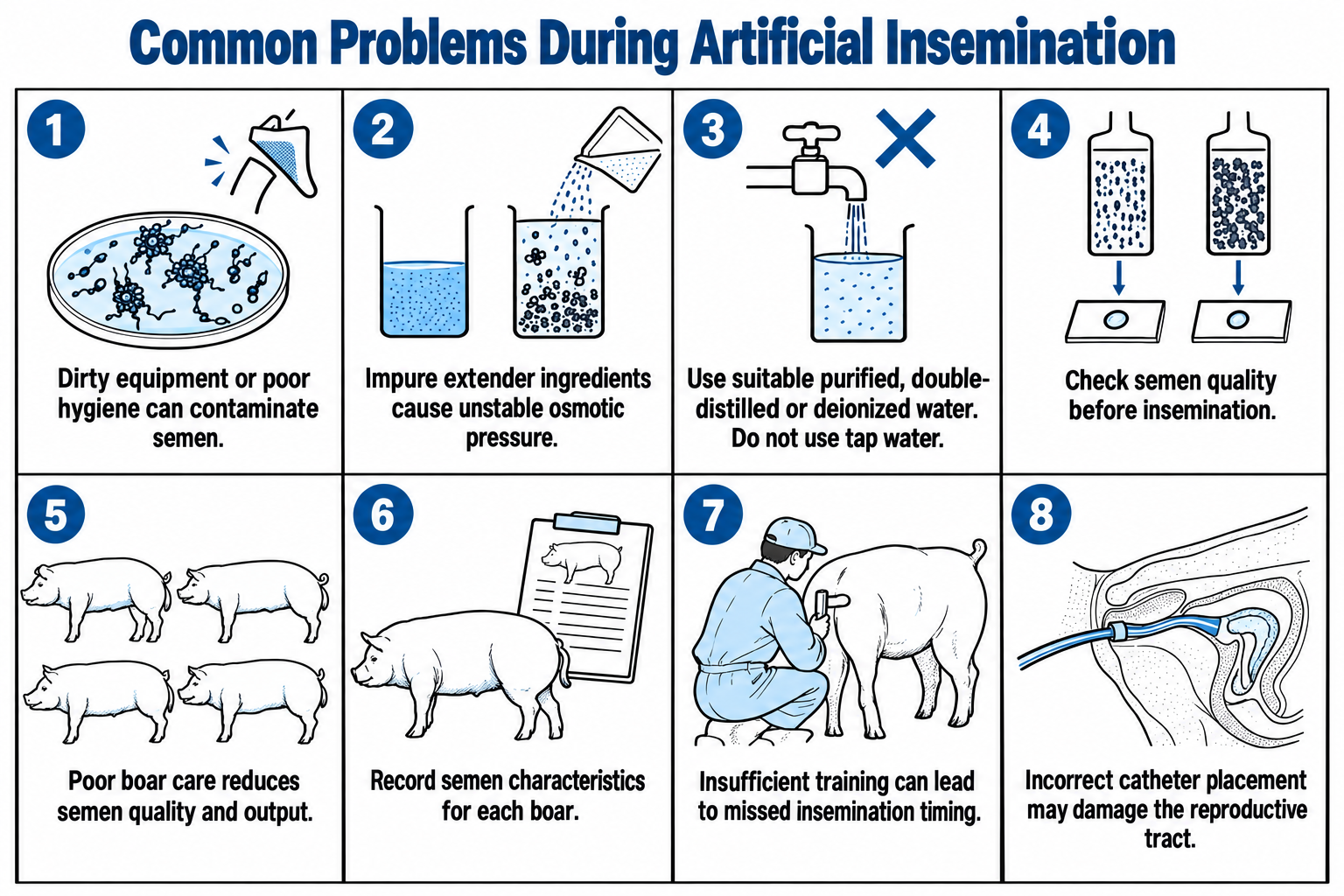
- Dirty equipment or poor hygiene can contaminate semen.
- Impure extender ingredients cause unstable osmotic pressure.
- Use suitable purified, double-distilled or deionized water. Do not use tap water.
- Check semen quality before insemination.
- Poor boar care reduces semen quality and output.
- Record semen characteristics for each boar.
- Insufficient training can lead to missed insemination timing.
- Incorrect catheter placement may damage the reproductive tract.
Treating the Boar Well Is Essential
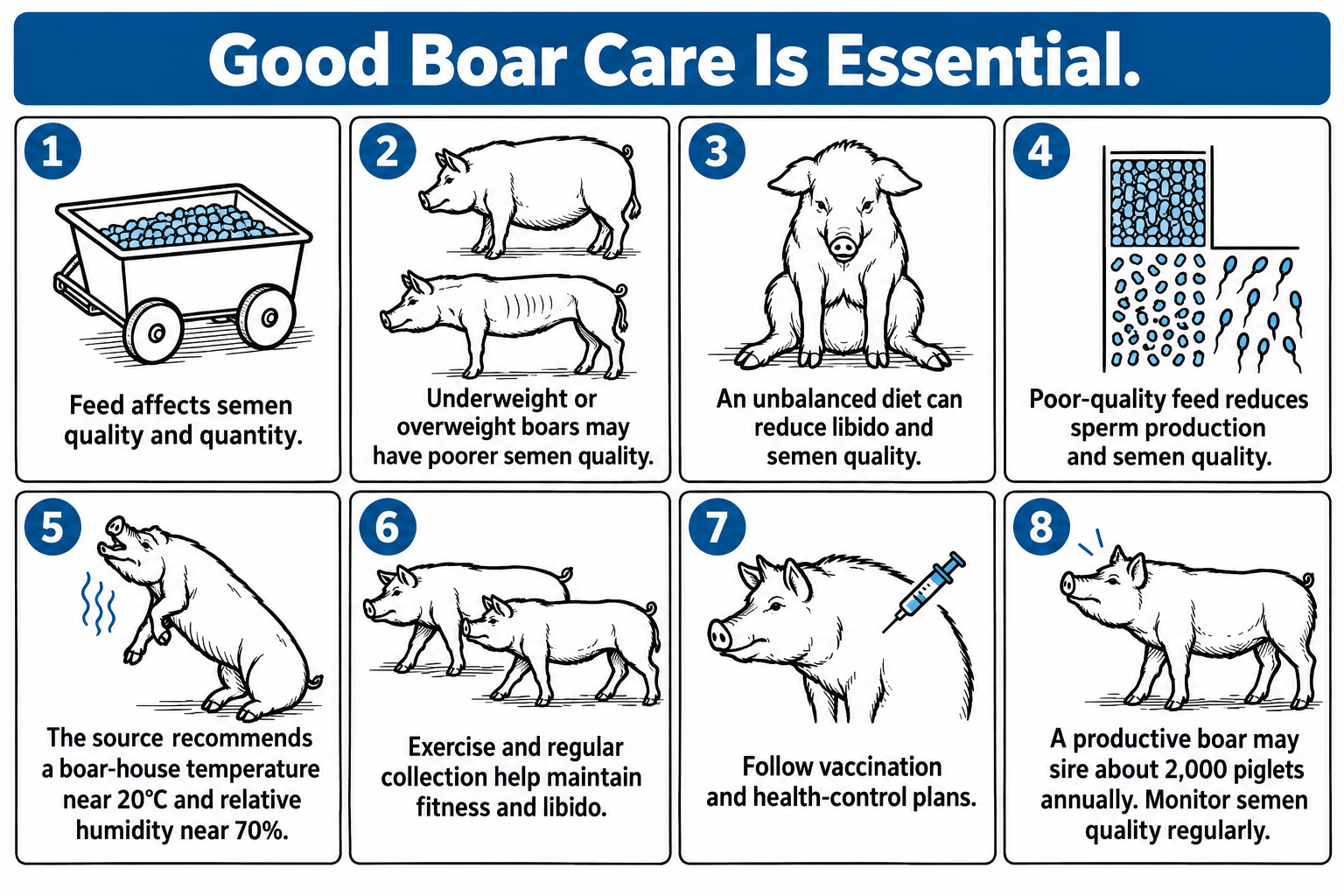
- Feed affects semen quality and quantity.
- Underweight or overweight boars may have poorer semen quality.
- An unbalanced diet can reduce libido and semen quality.
- Poor-quality feed reduces sperm production and semen quality.
- The source recommends a boar-house temperature near 20°C and relative humidity near 70%.
- Exercise and regular collection help maintain fitness and libido.
- Follow vaccination and health-control plans.
- A productive boar may sire about 2,000 piglets annually. Monitor semen quality regularly.
Acclimatizing a New Breeding Boar
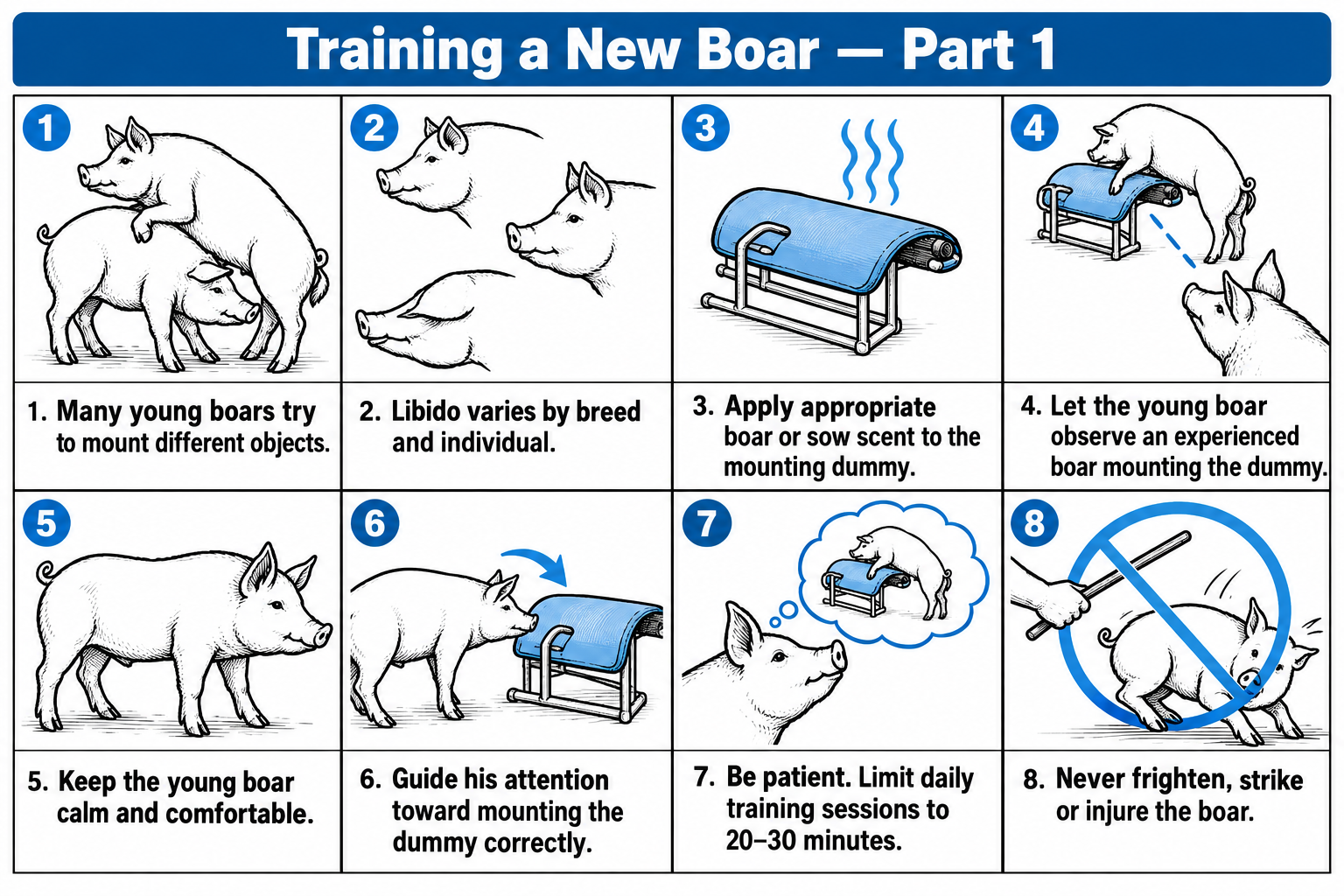
- Many young boars try to mount different objects.
- Libido varies by breed and individual.
- Apply appropriate boar or sow scent to the mounting dummy.
- Let the young boar observe an experienced boar mounting the dummy.
- Keep the young boar calm and comfortable.
- Guide his attention toward mounting the dummy correctly.
- Be patient. Limit daily training sessions to 20–30 minutes.
- Never frighten, strike or injure the boar.
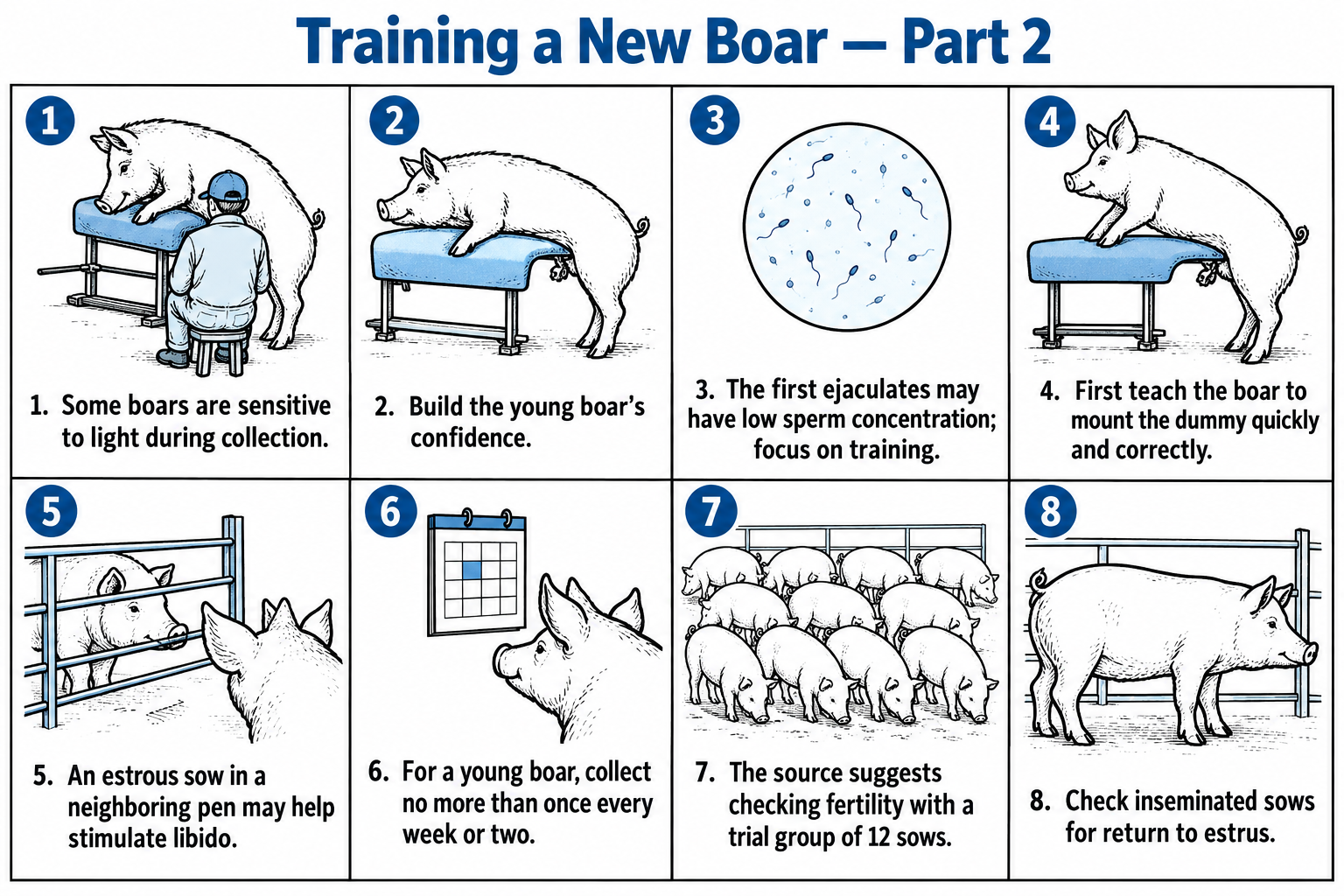
- Some boars are sensitive to light during collection.
- Build the young boar’s confidence.
- The first ejaculates may have low sperm concentration; focus on training.
- First teach the boar to mount the dummy quickly and correctly.
- An estrous sow in a neighboring pen may help stimulate libido.
- For a young boar, collect no more than once every week or two.
- The source suggests checking fertility with a trial group of 12 sows.
- Check inseminated sows for return to estrus.
Semen Collection (1)
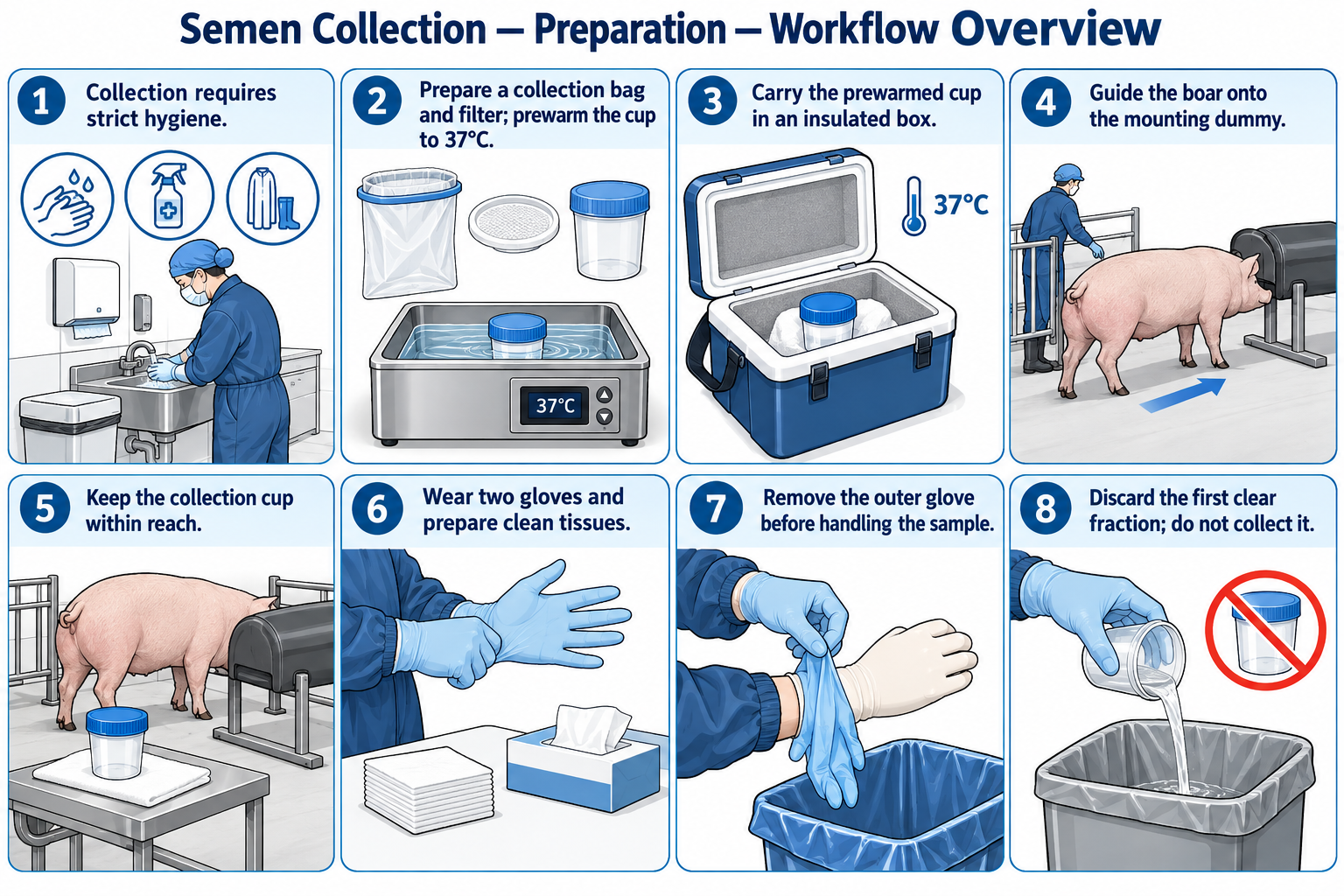
- Collection requires strict hygiene.
- Prepare a collection bag and filter; prewarm the cup to 37°C.
- Carry the prewarmed cup in an insulated box.
- Guide the boar onto the mounting dummy.
- Keep the collection cup within reach.
- Wear two gloves and prepare clean tissues.
- Remove the outer glove before handling the sample.
- Discard the first clear fraction; do not collect it.
Collection handling details: Wear two gloves. Wipe the prepuce with a clean tissue, then remove the outer glove. Grip the penis gently and maintain stimulation. Do not collect the first clear fraction.
Semen Collection (2)
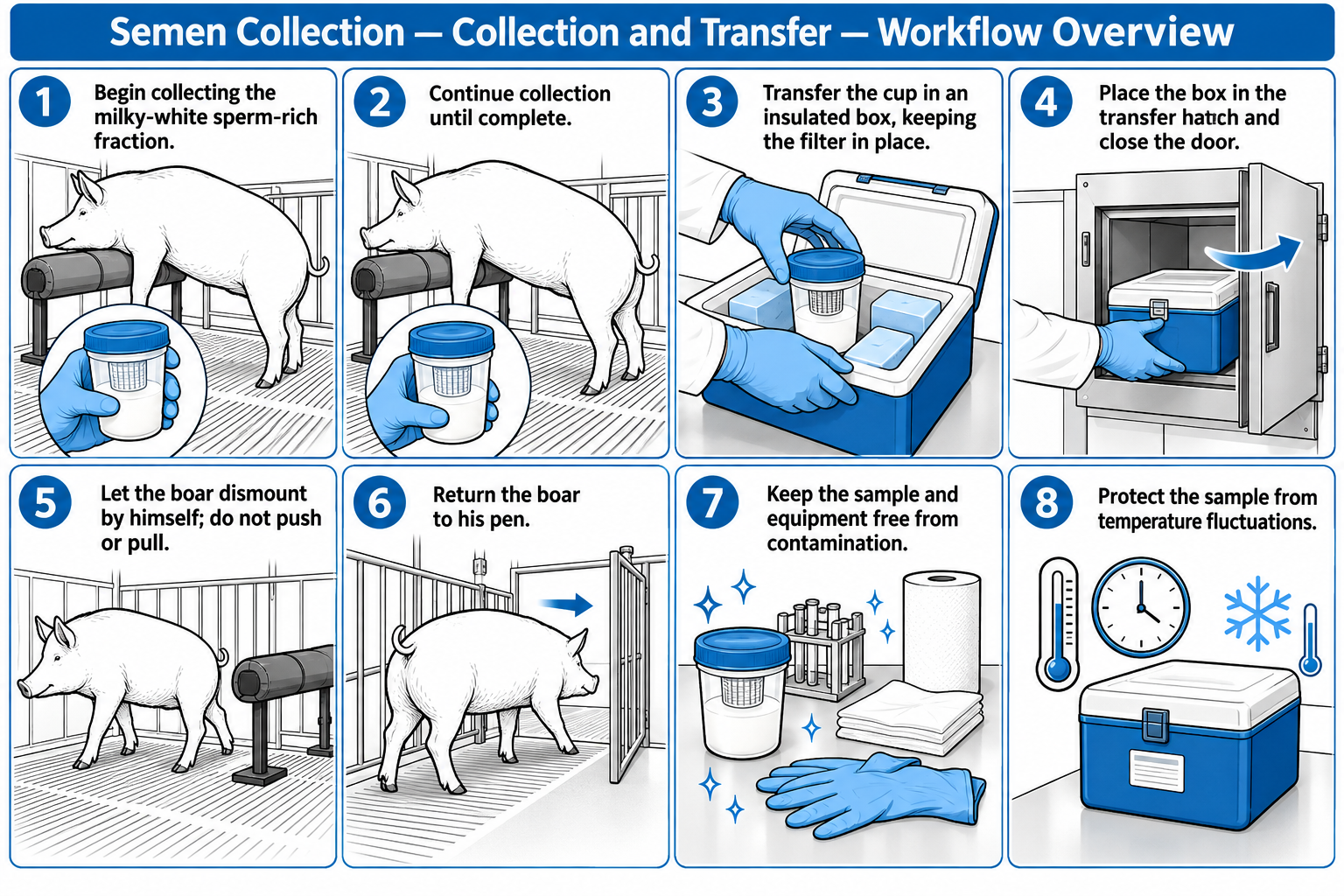
- Begin collecting the milky-white sperm-rich fraction.
- Continue collection until complete.
- Transfer the cup in an insulated box, keeping the filter in place.
- Place the box in the transfer hatch and close the door.
- Let the boar dismount by himself; do not push or pull.
- Return the boar to his pen.
- Keep the sample and equipment free from contamination.
- Protect the sample from temperature fluctuations.
Key Factors for Preserving Fresh Semen
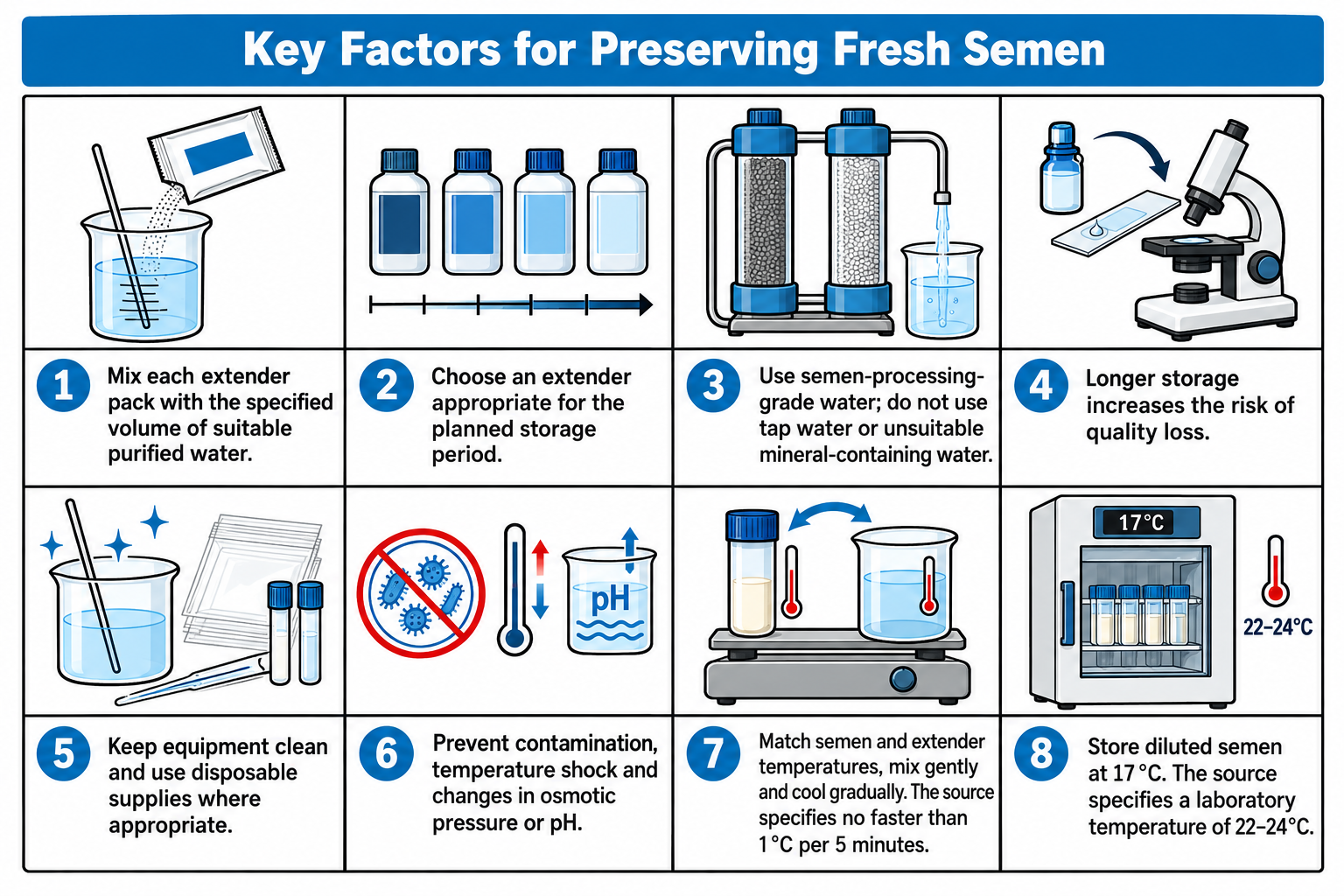
- Mix each extender pack with the specified volume of suitable purified water.
- Choose an extender appropriate for the planned storage period.
- Use semen-processing-grade water; do not use tap water or unsuitable mineral-containing water.
- Longer storage increases the risk of quality loss.
- Keep equipment clean and use disposable supplies where appropriate.
- Prevent contamination, temperature shock and changes in osmotic pressure or pH.
- Match semen and extender temperatures, mix gently and cool gradually. The source specifies no faster than 1°C per 5 minutes.
- Store diluted semen at 17°C. The source specifies a laboratory temperature of 22–24°C.
Steps for Diluting and Preserving Fresh Semen
Semen collection: 1. Induce the boar to mount the dummy sow; 2. Wipe the prepuce clean; 3. Grasp the penis; 4. Collect the concentrated fraction of the ejaculated semen; 5. Transport the collected semen to the laboratory.
Laboratory preparation before collection: 1. Turn on the thermostatic water bath and prewarming cabinet; 2. Mix the extender; 3. Prepare the collection cup; 4. Turn on and check all electronic equipment; 5. Prepare auxiliary supplies, containers and labels; 6. Ensure the extender is warmed to 37°C and allowed to equilibrate for at least 1 hour.
Processing and quality control: 1. Identify the boar; 2. Weigh the semen in its container; 3. Check semen color and odor; 4. Maintain a steady collection procedure; 5. Calculate sperm concentration; 6. Examine sperm morphology and motility under the microscope; 7. Calculate the number of doses from each collection (the source specifies at least 3 billion viable sperm per dose); 8. Add the calculated amount of extender.
Dispensing: 1. Prepare the insemination bottles and labels for dispensing the semen; 2. Cap the insemination bottles.
Storage: 1. Place the dispensed semen in a temperature-controlled refrigerator at 17°C; 2. Turn the insemination bottles once every 24 hours to keep the sperm evenly suspended; 3. Carefully avoid freezing in the refrigerator.
Transport: 1. If transport takes more than 30 minutes, it is best to use a mobile thermostatic refrigerator; 2. If transport does not exceed 30 minutes, an insulated box with ice packs may be used; 3. Sample and inspect the semen of every collection before insemination.
Insemination: 1. Estrus detection; 2. Organize the insemination area; 3. Standardize the operating procedure; 4. Use disposable equipment to prevent urinary tract infections; 5. Care for the sow after insemination.
Preparations in the Laboratory Before Semen Collection
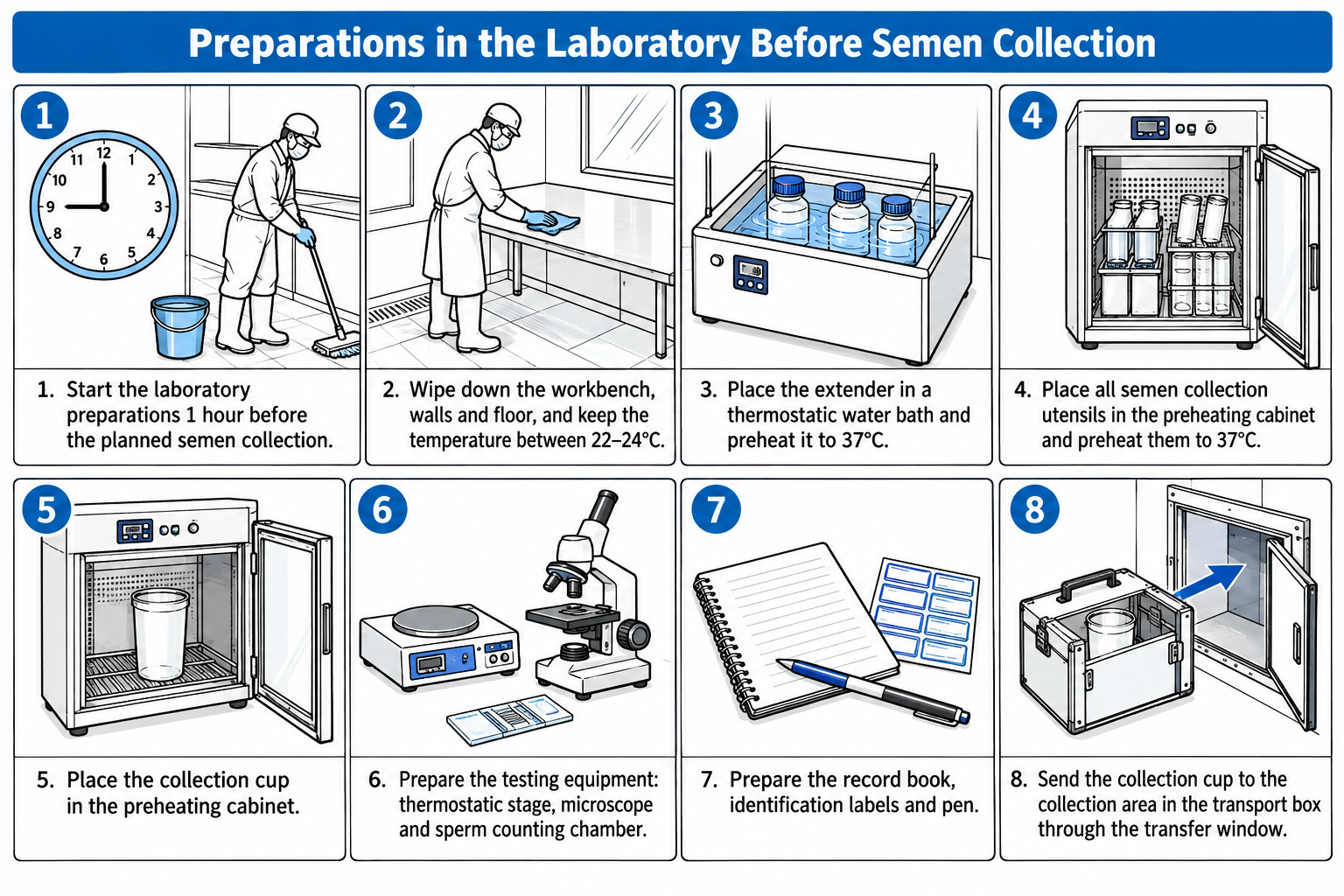
1. Start the laboratory preparations 1 hour before the planned semen collection.
2. Wipe down the workbench, walls and floor, and keep the temperature between 22–24°C.
3. Place the extender in a thermostatic water bath and preheat it to 37°C.
4. Place all semen collection utensils in the preheating cabinet and preheat them to 37°C.
5. Place the collection cup in the preheating cabinet.
6. Prepare the testing equipment: thermostatic stage, microscope and sperm counting chamber.
7. Prepare the record book, identification labels and pen.
8. Send the collection cup to the collection area in the transport box through the transfer window.
Preparing Semen in the Laboratory
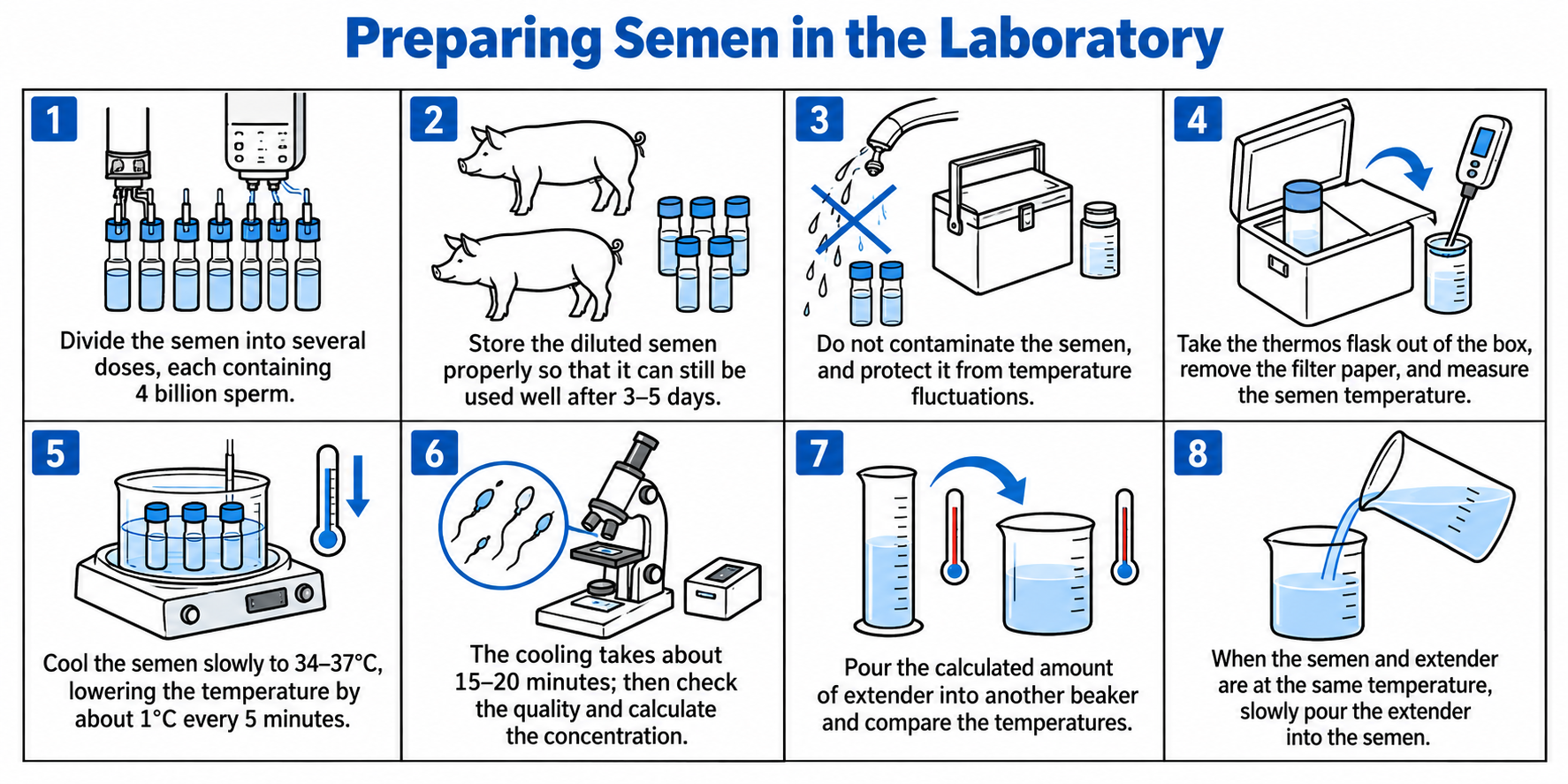
1. Divide the semen into several doses, each containing 4 billion sperm.
2. Store the diluted semen properly so that it can still be used well after 3–5 days.
3. Do not contaminate the semen, and protect it from temperature fluctuations.
4. Take the thermos flask out of the box, remove the filter paper, and measure the semen temperature.
5. Cool the semen slowly to 34–37°C, lowering the temperature by about 1°C every 5 minutes.
6. The cooling takes about 15–20 minutes; then check the quality and calculate the concentration.
7. Pour the calculated amount of extender into another beaker and compare the temperatures.
8. When the semen and extender are at the same temperature, slowly pour the extender into the semen.
8 Steps of Semen Processing and Quality Control
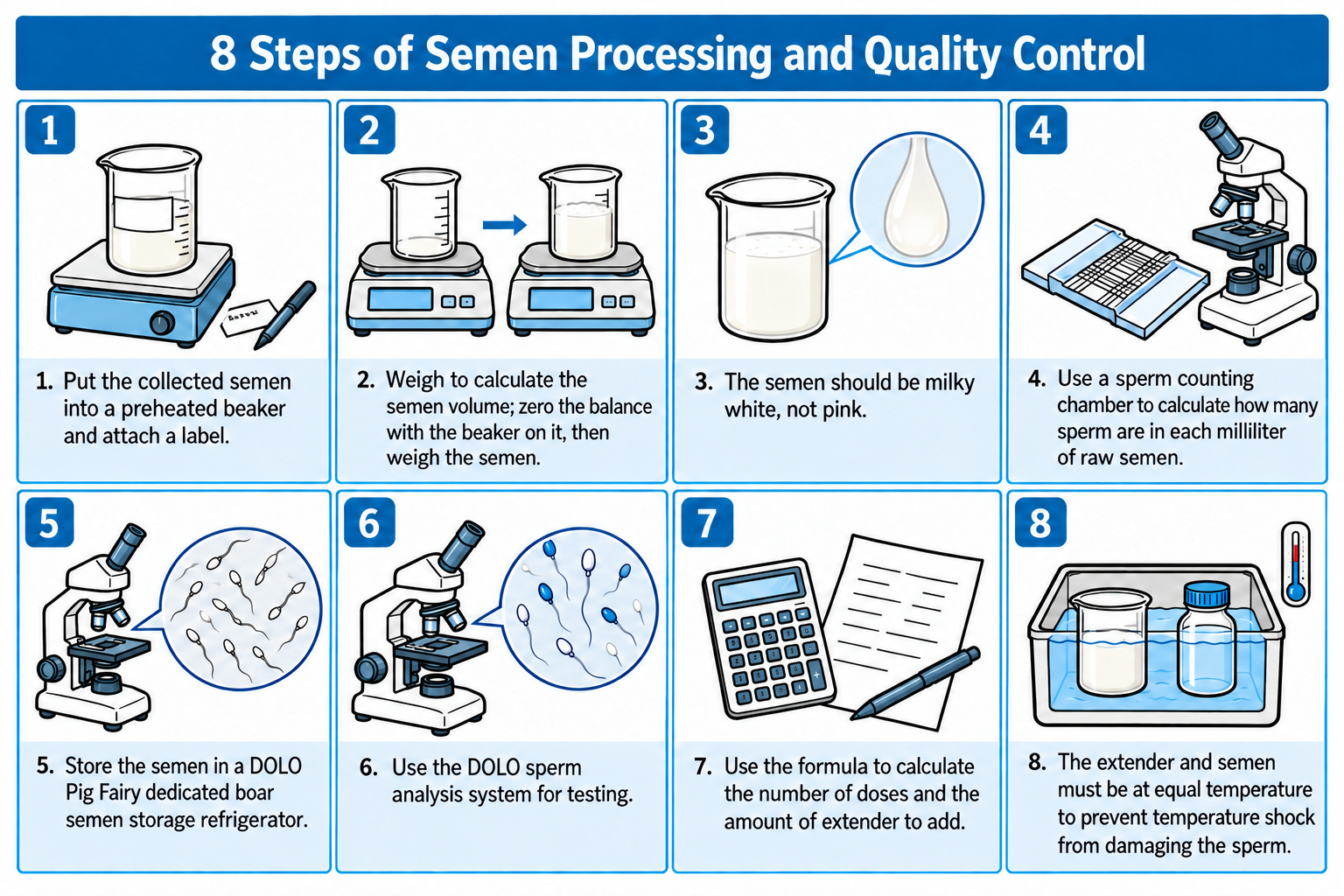
1. Put the collected semen into a preheated beaker and attach a label.
2. Weigh to calculate the semen volume; zero the balance with the beaker on it, then weigh the semen.
3. The semen should be milky white, not pink.
4. Use a sperm counting chamber to calculate how many sperm are in each milliliter of raw semen.
5. Store the semen in a DOLO Pig Fairy dedicated boar semen storage refrigerator.
6. Use the DOLO sperm analysis system for testing.
7. Use the formula to calculate the number of doses and the amount of extender to add.
8. The extender and semen must be at equal temperature to prevent temperature shock from damaging the sperm.
Aliquoting and Storing Diluted Semen
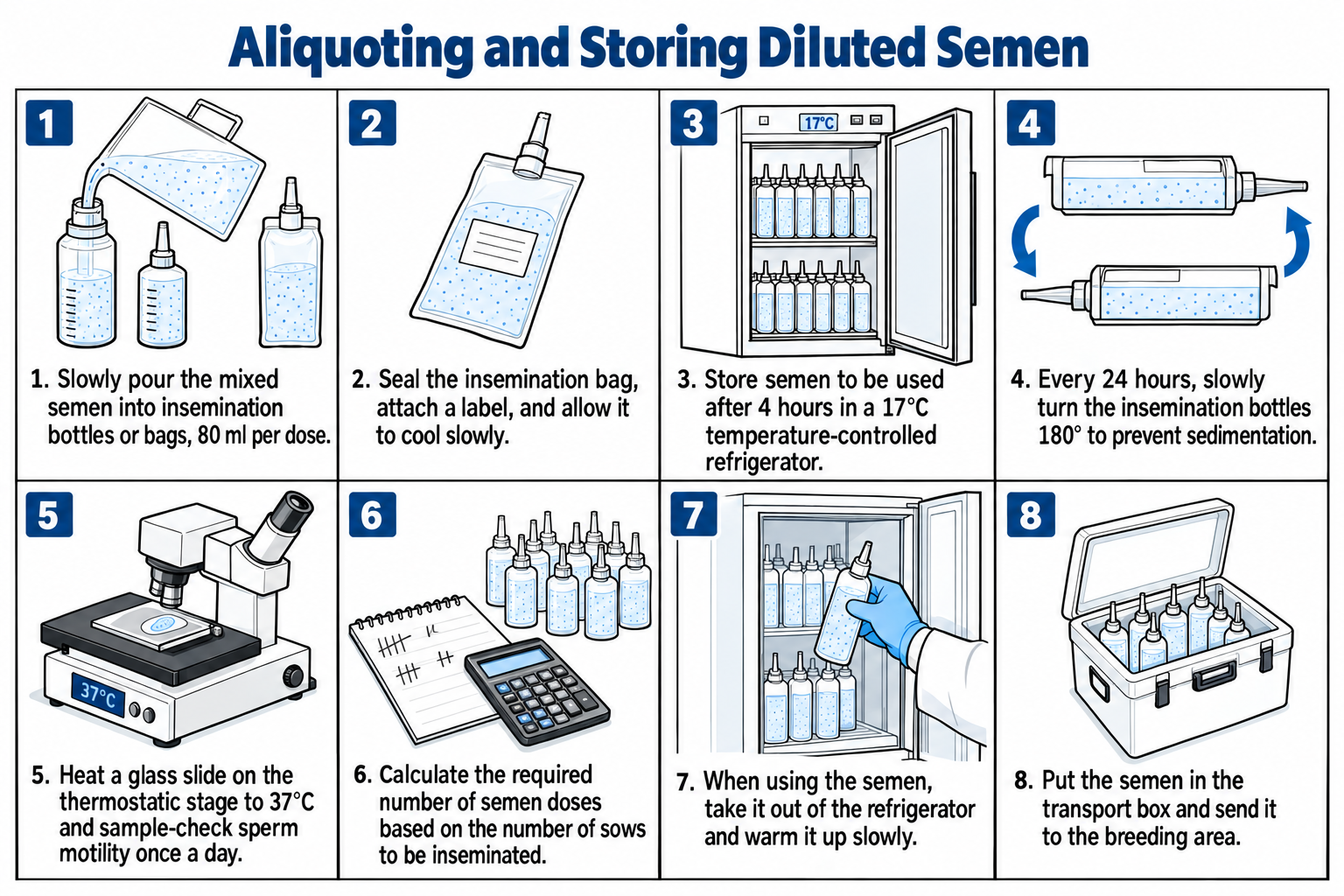
1. Slowly pour the mixed semen into insemination bottles or bags, 80 ml per dose.
2. Seal the insemination bag, attach a label, and allow it to cool slowly.
3. Store semen to be used after 4 hours in a 17°C temperature-controlled refrigerator.
4. Every 24 hours, slowly turn the insemination bottles 180° to prevent sedimentation.
5. Heat a glass slide on the thermostatic stage to 37°C and sample-check sperm motility once a day.
6. Calculate the required number of semen doses based on the number of sows to be inseminated.
7. When using the semen, take it out of the refrigerator and warm it up slowly.
8. Put the semen in the transport box and send it to the breeding area.
Conception Steps
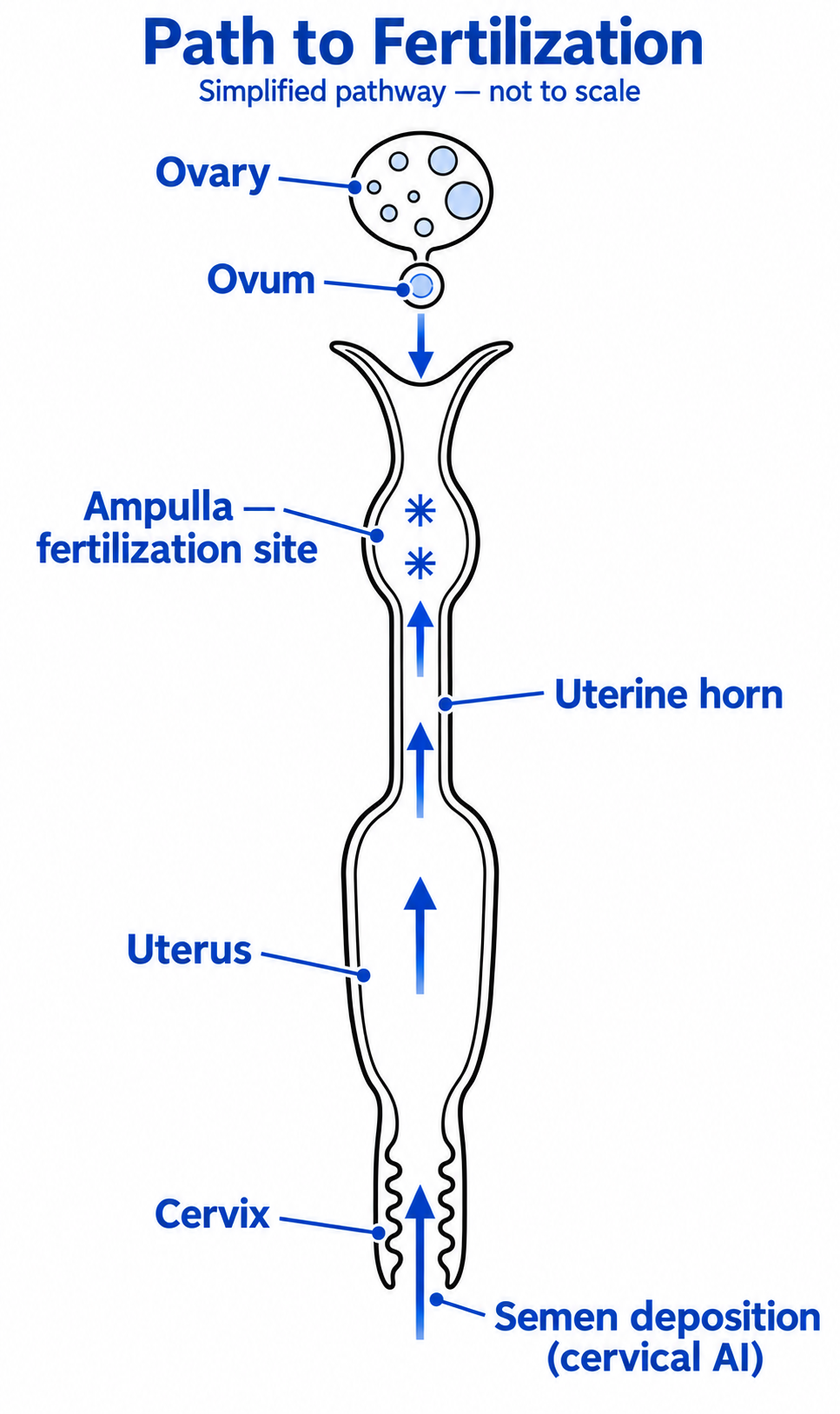
- The definition of estrus is when the sow stands still in standing estrus.
- A sow in standing estrus may not be detected for several hours.
- Ovulation starts 36–72 hours after estrus begins, and ovulation usually lasts 4–6 hours.
- It takes the egg about 30–45 minutes to reach the ampulla, which is the best site for conception.
- The egg stays at the lower end of the ampulla for at most 8 hours, when its vitality is strongest.
- Once mature, sperm can retain their vitality for at most 24 hours.
- The sperm swim through a narrow passage to the fertilization site.
- The sperm need an 8-hour maturation period before they can fertilize the egg.
- The sperm are quickly transported to the tip of the uterus.
- The semen is deposited at the cervical opening at the tip of the uterus; the best conception result is achieved by inseminating 12 hours before ovulation.
Qualities of a Teaser Boar
- Strong male odor: it will “talk” to the sows, produces plenty of saliva, and its saliva contains pheromones.
- It knows how to “talk” to the sows before mounting them.
- It has patience — it does not become angry when it cannot be used for breeding.
- Gentle and patient — it cooperates well with the sow.
- Manageable — you can move it from one pen to another whenever needed.
- Reliable — it knows the daily routine of working with the sows.
- Active — it should continue working when another sow comes into estrus.
- Good temperament — it will not attack the inseminator.
Note: Some breeds and lines are easier to train as teaser boars.
Steps for Detecting Estrus
- Mounting another sow signals that estrus is about to begin.
- Reduced appetite.
- Restlessness — while other sows rest, she shows signs of seeking the boar.
- An eager expression; her eyes lose focus.
- Ears pricked upward; the body trembles.
- Standing still when back-pressure is applied (standing estrus).
- Tail swishing up and down; red, swollen vulva.
- Mucus discharge from the vagina; the sow’s vagina is mature.
- Placing fingers between the vulvar lips gives a moist, warm feeling.
During estrus the sow shows all or some of the above signs.
Insemination Timing
| #1 Sow: standing estrus 3–4 days after weaning | AM PM | Estrus detected | Insemination | Insemination | Insemination | PM AM | Estrus detected | Insemination | Insemination | Insemination |
| Insemination | Insemination | Insemination | Insemination | |||||||
| #2 Sow: standing estrus 5–7 days after weaning | AM PM | Estrus detected | Insemination | PM AM | Estrus detected | Insemination | Insemination | |||
| Insemination | Insemination | Insemination | Insemination | Insemination | ||||||
| #3 Sow: standing estrus more than 7 days after weaning | AM PM | Estrus / Insemination | Insemination | PM AM | Estrus / Insemination | Insemination | ||||
| Insemination | Insemination | |||||||||
| #4 Gilt | AM PM | Estrus / Insemination | Insemination | PM AM | Estrus / Insemination | Insemination | ||||
| Insemination | Insemination | |||||||||
| #5 Sow treated with PG600 (gilts + sows) | AM | Estrus / Insemination | Insemination | PM | Estrus / Insemination | Insemination | ||||
| PM | Insemination | AM | Insemination | |||||||
| PM | 1–24 h | 25–48 h | 49–72 h | 73–96 h | AM | 1–24 h | 25–48 h | 49–72 h | 73–96 h | |
| Day 1 | Day 2 | Day 3 | Day 4 | Day 1 | Day 2 | Day 3 | Day 4 |
The Role of the Teaser Boar in Estrus Detection
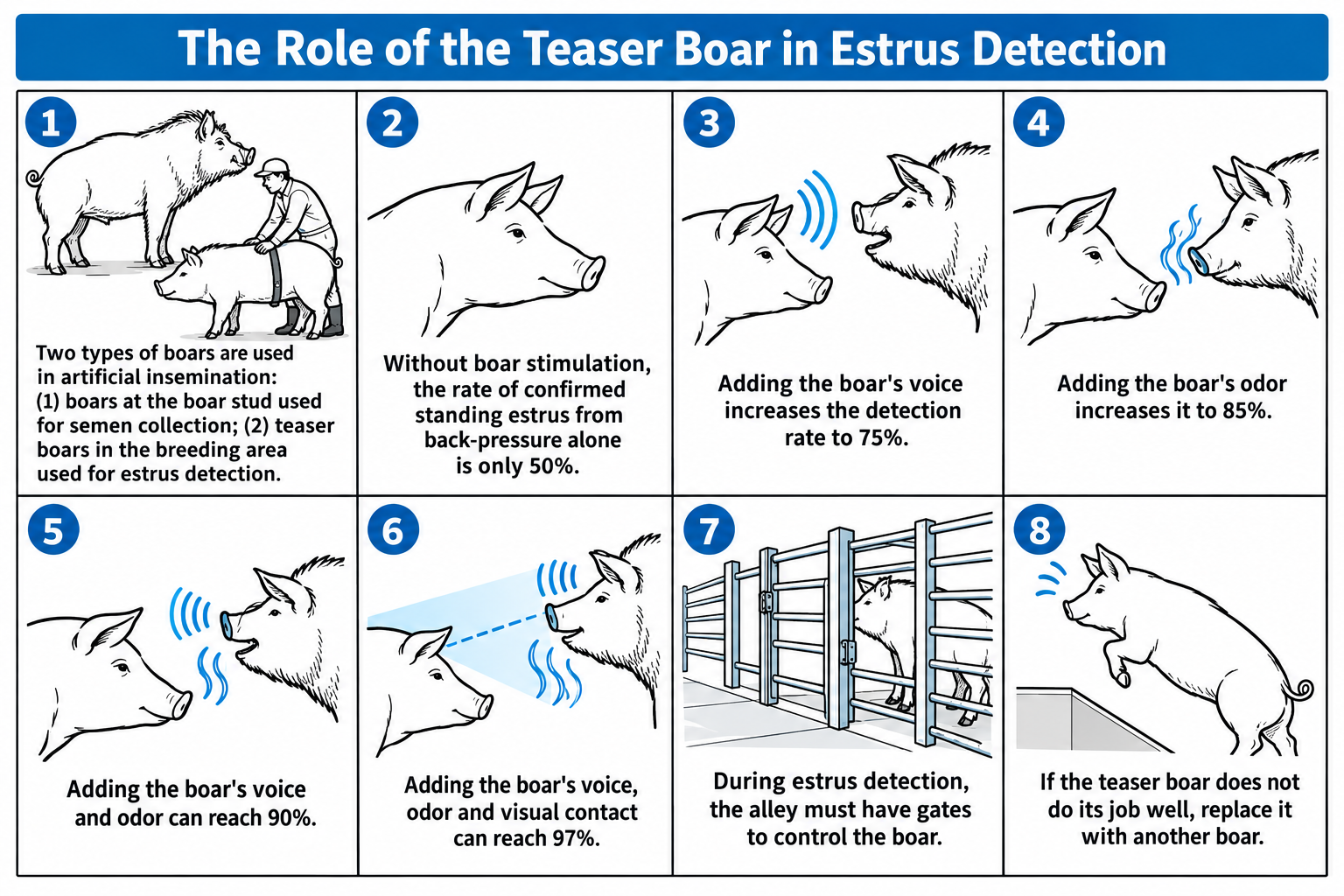
1. Two types of boars are used in artificial insemination: (1) boars at the boar stud used for semen collection; (2) teaser boars in the breeding area used for estrus detection.
2. Without boar stimulation, the rate of confirmed standing estrus from back-pressure alone is only 50%.
3. Adding the boar’s voice increases the detection rate to 75%.
4. Adding the boar’s odor increases it to 85%.
5. Adding the boar’s voice and odor can reach 90%.
6. Adding the boar’s voice, odor and visual contact can reach 97%.
7. During estrus detection, the alley must have gates to control the boar.
8. If the teaser boar does not do its job well, replace it with another boar.
Caring for Weaned Sows
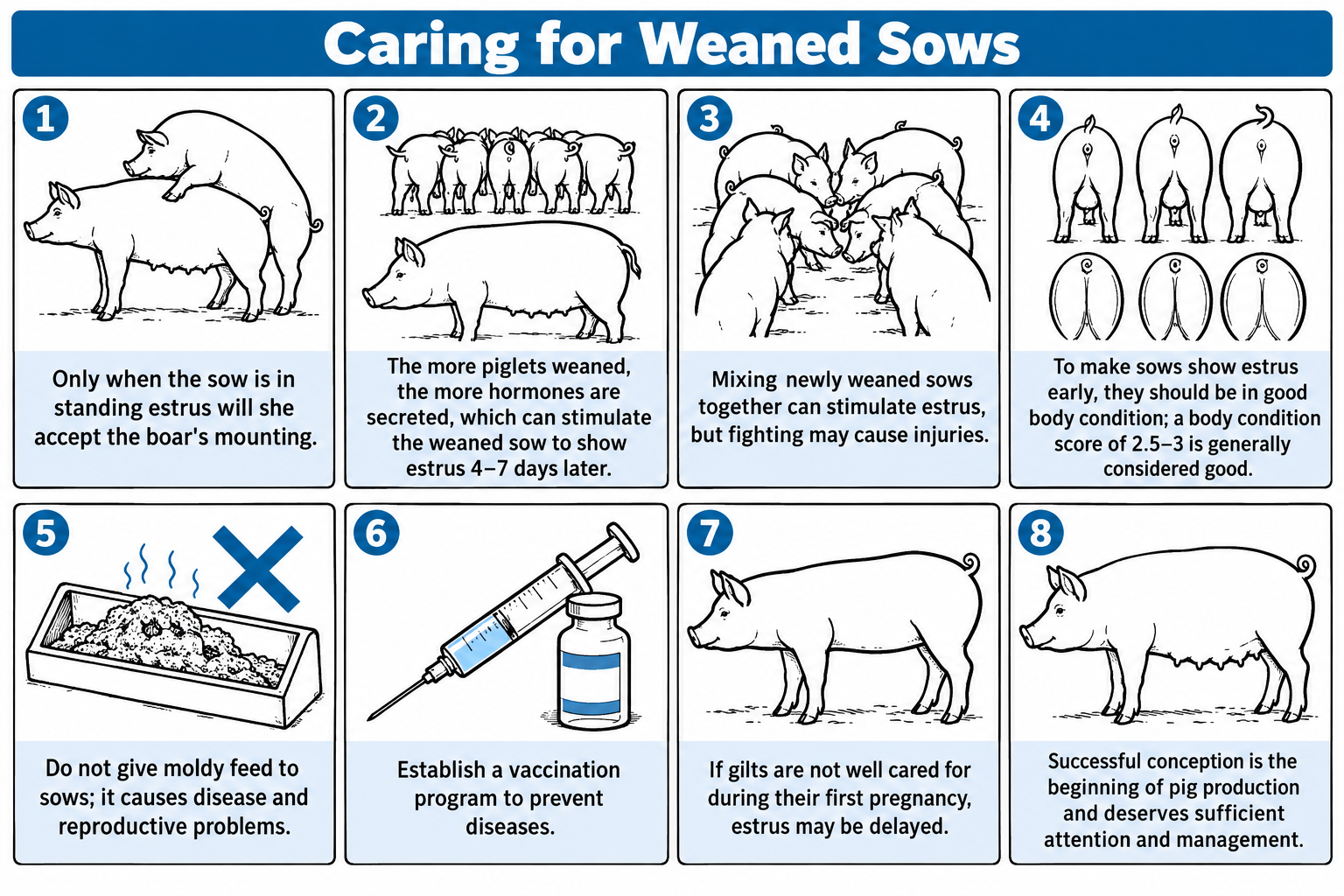
1. Only when the sow is in standing estrus will she accept the boar’s mounting.
2. The more piglets weaned, the more hormones are secreted, which can stimulate the weaned sow to show estrus 4–7 days later.
3. Mixing newly weaned sows together can stimulate estrus, but fighting may cause injuries.
4. To make sows show estrus early, they should be in good body condition; a body condition score of 2.5–3 is generally considered good.
5. Do not give moldy feed to sows; it causes disease and reproductive problems.
6. Establish a vaccination program to prevent diseases.
7. If gilts are not well cared for during their first pregnancy, estrus may be delayed.
8. Successful conception is the beginning of pig production and deserves sufficient attention and management.
Preparing the Sow for Insemination
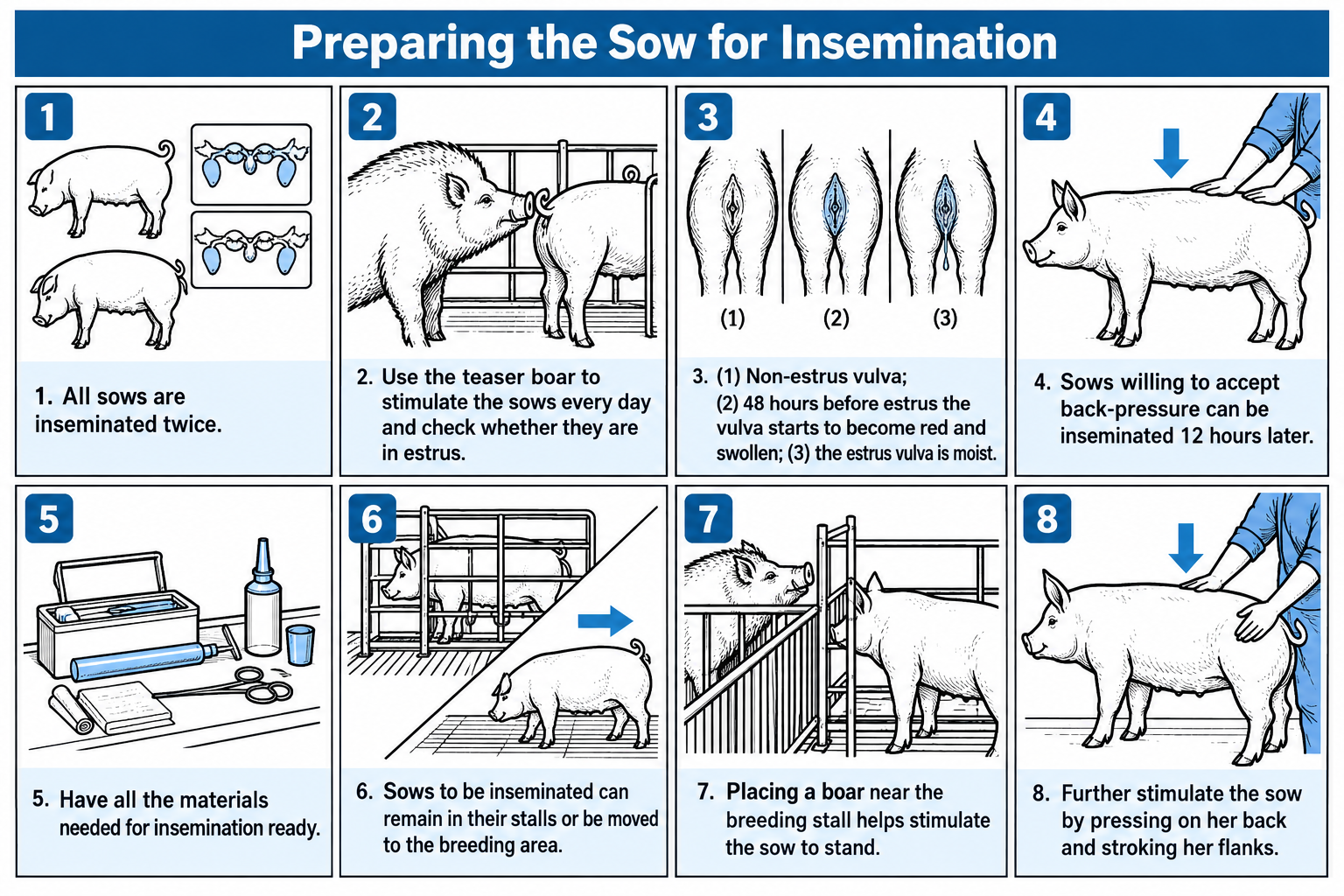
1. All sows are inseminated twice.
2. Use the teaser boar to stimulate the sows every day and check whether they are in estrus.
3. (1) Non-estrus vulva; (2) 48 hours before estrus the vulva starts to become red and swollen; (3) the estrus vulva is moist.
4. Sows willing to accept back-pressure can be inseminated 12 hours later.
5. Have all the materials needed for insemination ready.
6. Sows to be inseminated can remain in their stalls or be moved to the breeding area.
7. Placing a boar near the breeding stall helps stimulate the sow to stand.
8. Further stimulate the sow by pressing on her back and stroking her flanks.
Insemination
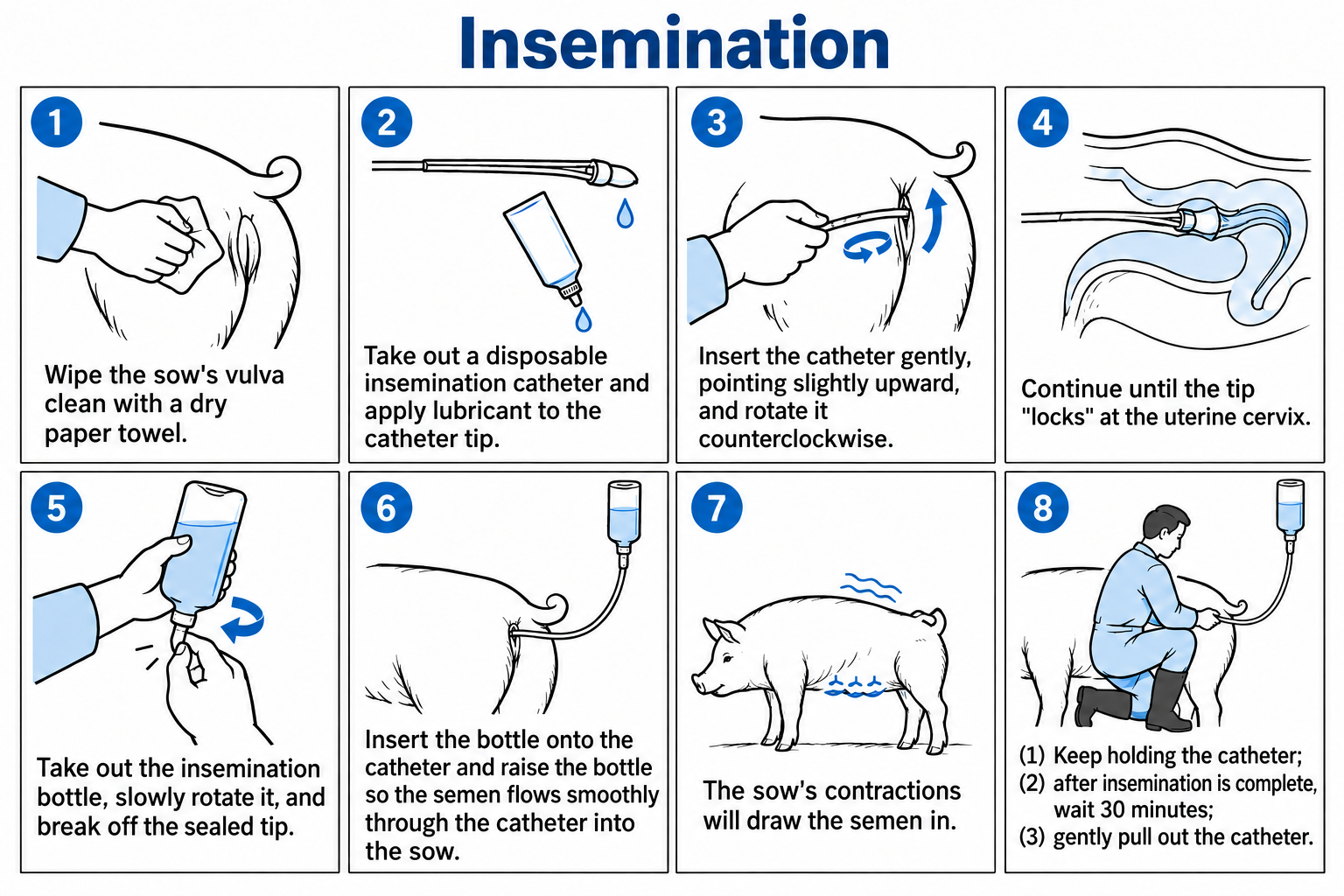
1. Wipe the sow’s vulva clean with a dry paper towel.
2. Take out a disposable insemination catheter and apply lubricant to the catheter tip.
3. Insert the catheter gently, pointing slightly upward, and rotate it counterclockwise.
4. Continue until the tip “locks” at the uterine cervix.
5. Take out the insemination bottle, slowly rotate it, and break off the sealed tip.
6. Insert the bottle onto the catheter and raise the bottle so the semen flows smoothly through the catheter into the sow.
7. The sow’s contractions will draw the semen in.
8. (1) Keep holding the catheter; (2) after insemination is complete, wait 30 minutes; (3) gently pull out the catheter.
Insemination Precautions
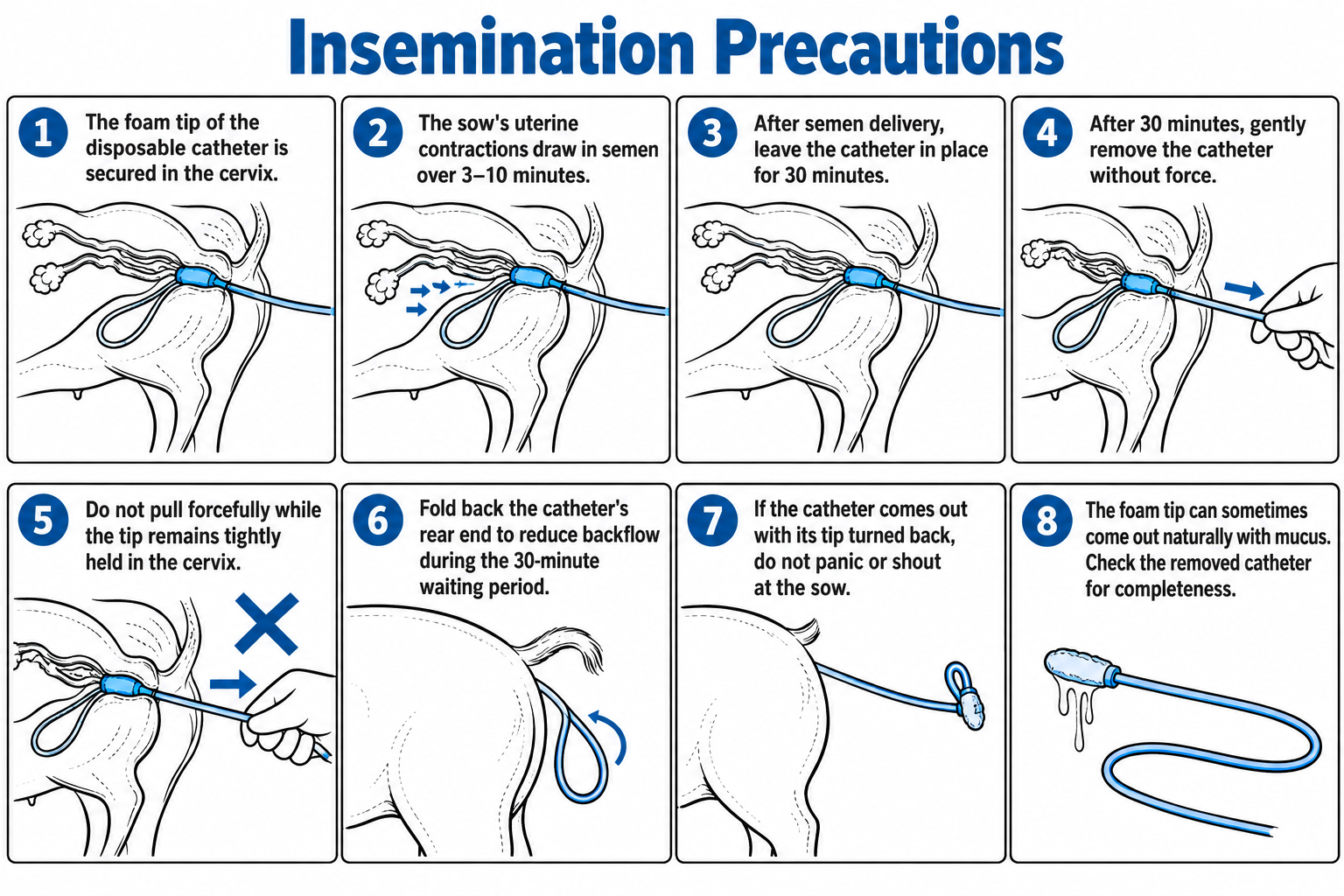
- The sponge head of the disposable insemination catheter is locked inside the uterine cervix.
- The sow’s internal contractions draw the semen into the body within 3-10 minutes.
- When the semen has been delivered, leave the catheter in place for 30 minutes.
- Then gently and steadily pull the catheter downward out of the cervix.
- While the catheter head is still tightly locked in the cervix, do not pull outward forcefully.
- After insemination, fold back the rear of the catheter to reduce semen backflow during the 30-minute waiting period. Then gently remove the catheter.
- If the catheter comes out with its tip turned back, do not panic or shout at the sow.
- The foam tip can sometimes come out naturally with mucus. Check the removed catheter for completeness.
Care of the Sow after Insemination
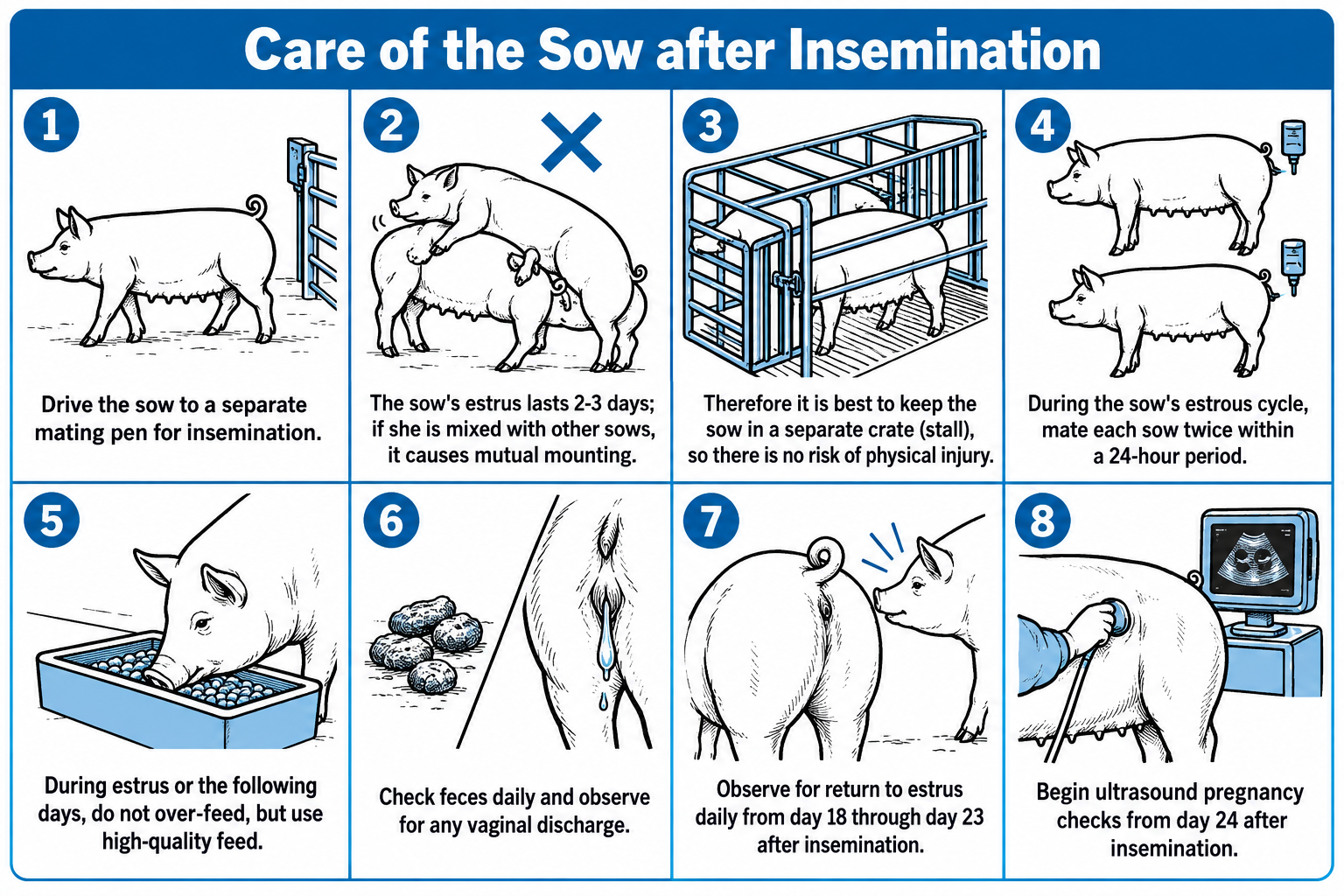
- Drive the sow to a separate mating pen for insemination.
- The sow’s estrus lasts 2-3 days; if she is mixed with other sows, it causes mutual mounting.
- Therefore it is best to keep the sow in a separate crate (stall), so there is no risk of physical injury.
- During the sow’s estrous cycle, mate each sow twice within a 24-hour period.
- During estrus or the following days, do not over-feed, but use high-quality feed.
- Check feces daily and observe for any vaginal discharge.
- Observe for return to estrus daily from day 18 through day 23 after insemination.
- Begin ultrasound pregnancy checks from day 24 after insemination.
Semen Collection Area Layout Plan (4 m x 4 m)
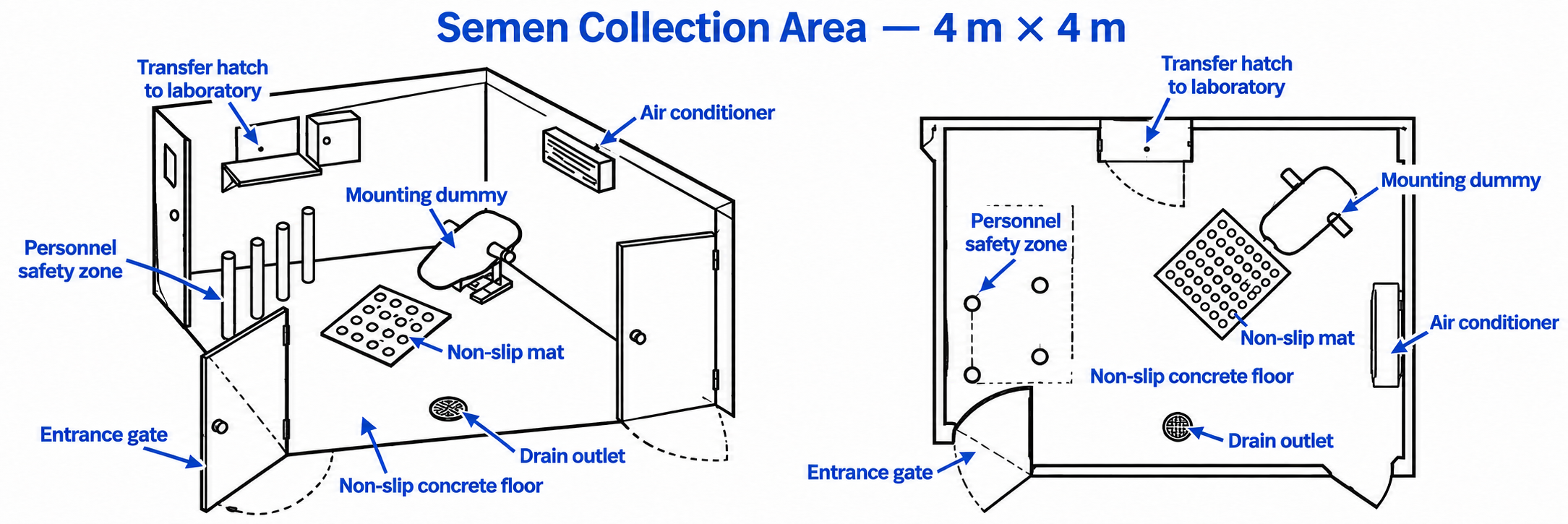
- Separated from the boar housing area by walls and doors.
- Strictly control the temperature at 18°C to 24°C.
- The dummy sow is firmly installed on the floor; place a mating mat underneath so the boar has secure footing.
- A personnel safety zone must be designed.
- Provide a pass-through window to the laboratory.
- Provide a non-slip cement floor with a sewage outlet.
Pig Farm Artificial Insemination Laboratory Configuration
I. Laboratory (Basic AI Equipment / Instruments / Consumables):
| Product | Model & Performance Description | Unit | Unit Price | Qty | Amount |
|---|---|---|---|---|---|
| Dummy sow (mounting dummy) | Canvas and leather types, for semen collection; adjustable height and angle | set | |||
| Anti-slip mat | Thick/thin types, eco-friendly rubber, no talcum powder additive | set | |||
| Short-distance transport box | 5 L / 14 L, holds 15 / 50 bottles of semen | set | |||
| 17°C constant-temperature refrigerator | 50 L / 70 L / 95 L (built-in type, external type), for semen storage | set | |||
| Digital constant-temperature water bath | HH-1/2/4/6 digital temperature control, room temp to 100°C, accuracy +/-1°C | set | |||
| Thermostatic magnetic heating stirrer | FEB85-2/1, speed adjustment R/MIN | set | |||
| Glass double-distillation water unit | Output 2 L/hour, for preparing semen diluent water | set | |||
| Glass distilled-water storage bottle | 5000 ML / 10000 ML, for holding distilled water | set | |||
| Electronic precision platform scale | 0.2-3 KG, for weighing semen and diluent powder | set | |||
| 37°C digital constant-temperature plate | For heating glass slides | set | |||
| Digital blast drying oven | Shanghai 101A-1, inner size 350*450*450, temperature control 50-300°C | set | |||
| Digital electric incubator | Shanghai 303A-1, inner size 420*360*360, working temperature 60°C | set | |||
| Monocular/binocular biological microscope | 640x / 1000x / 1600x, Shanghai / Nanjing | set | |||
| Sperm density meter (spectrophotometer) | France / Germany / Italy / domestic S22PC | set | |||
| Pipette | 100-500 UL / 200-1000 UL / 200-5000 UL | piece | |||
| Adjustable micro dispenser | 5 ML / 10 ML | each | |||
| Sperm counting chamber | For counting raw sperm concentration | block | |||
| Insulated collection cup | 600 ML / 2000 ML | each | |||
| Red-liquid thermometer | Domestic / export type | piece | |||
| Mercury thermometer | Domestic / export type | piece | |||
| Handled plastic measuring cup | 500 ML / 1000 ML / 2000 ML / 5000 ML | each | |||
| Glass beaker | 500 ML / 1000 ML / 2000 ML / 3000 ML | each | |||
| Glass funnel | 90 MM | ||||
| Glass pipette | Large, medium, small sizes | ||||
| Plastic washing bottle | 250 ML / 500 ML | ||||
| Glass test tube | 5 ml / piece | ||||
| Test tube rack | 30 holes | ||||
| Glass stirring rod | 30 cm / piece | ||||
| Glass slide | 50 pieces / box | ||||
| Coverslip | 100 pieces / box | ||||
| Sow record card | Ear number, parity, age, litter size | ||||
| Disposable first-parity sponge-head insemination catheter | Model 10011A Duole brand, for first-parity sows | ||||
| Disposable multiparous sponge-head insemination catheter | Model 10013A Duole brand, for multiparous sows | ||||
| 2 L diluent mixing bag | For mixing semen diluent | ||||
| 1 L sterile collection bag | Placed in the collection cup during collection, keeps warm | ||||
| Disposable coverall protective suit | Large, medium, small sizes | ||||
| Disposable collection gloves | PZ, non-slip, 50 pairs / pack | ||||
| Semen diluent powder | Imported, diluted with 1000 ml distilled water | ||||
| Lubricant | For lubrication during insemination, uterine anti-inflammation | ||||
| Semen filter paper | 20*20, for filtering semen during collection | ||||
| Microscope lens cleaning paper | For cleaning microscope lenses | ||||
| Qualitative filter paper | 12.5 CM | ||||
| Eosin stain | For examining sperm abnormality rate | ||||
| Subtotal |
Note: The above configuration covers the equipment, instruments, and consumables needed by large, medium, and small pig farms to establish a pig artificial insemination laboratory. We will tailor an economical configuration according to the scale of your farm, striving for satisfactory results.
Foshan Duole Livestock Equipment Co., Ltd. (Duole)
Guangdong Pig Breeding Technology Co., Ltd.
Contact Us
Foshan DOLO Animal Husbandry Machinery Co., Ltd
Email: [email protected]
WhatsApp: +86 189 2626 4642
https://wa.me/8618926264642
Telephone: +86 189 2626 4642
China Service Hotline: 400-0077-619
Website: www.chinapig.ai
Additional Website: www.zhuxianzi.com
Address: Building 9, 5th Floor, South China Life Science Park, Foshan, Guangdong, China.